Reducing Customer Wait Times: Queue and Drive-Thru Tech for 2026
Cutting customer wait times is one of the highest-return improvements any service business can make, and in 2026 the tools to do it are more capable and affordable than ever. Whether visitors line up inside a branch or roll through a drive-thru lane, the same core idea applies: measure the flow, remove the friction, and use technology to keep people moving. This guide focuses on two proven approaches, indoor queuing and drive-thru order systems, and how to combine them into a single, well-supported operation.
We will look at where wait time really comes from, the technology that attacks each bottleneck, how to compare indoor versus drive-thru solutions, and the telecom groundwork that makes any of it reliable.
Where Customer Wait Time Actually Comes From
Most managers assume wait time is simply “not enough staff.” In practice it is usually a mix of causes, and each one responds to a different fix. Breaking the problem down is the first step to solving it.
- Uneven arrivals. Everyone shows up at lunch or after work, overwhelming counters that sit idle at other times.
- Poor routing. A customer needing a two-minute task waits behind someone with a twenty-minute one.
- No visibility. Without data, managers cannot see which service types or lanes clog up.
- Manual handoffs. Paper tickets, shouted numbers, and radio calls all add delay and error.
Technology addresses every one of these. Smart routing sends short tasks to fast counters. Analytics reveal the true peaks so staffing matches demand. And automated calling removes the human bottleneck of managing the line by hand.
Indoor Queue Management: The Foundation
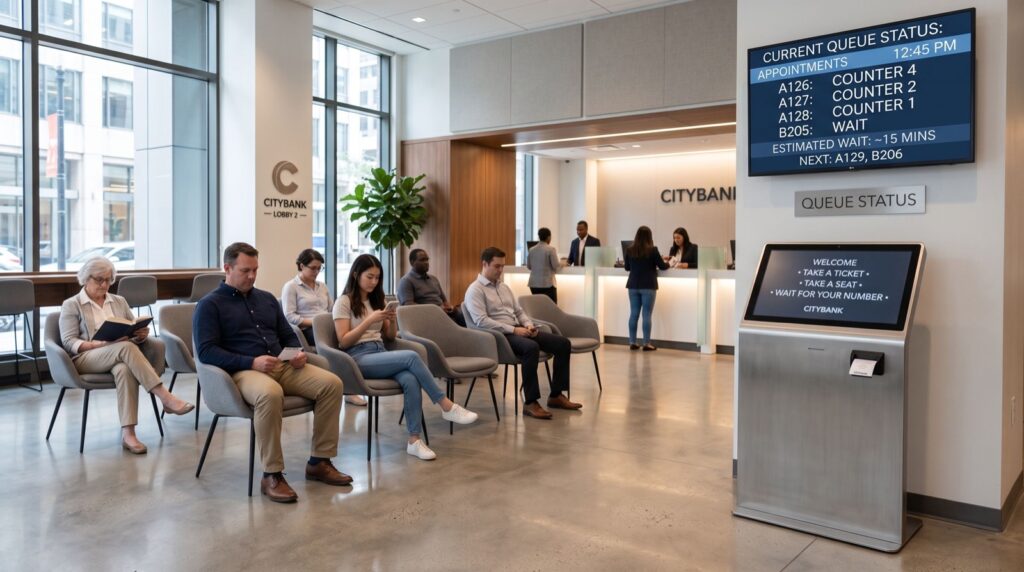
For branches, clinics, and service centers, an indoor queue system is the backbone. Customers check in at a kiosk or by phone, the platform routes them to the right desk, and displays call them forward in order. The real payoff is the data: once you can see average wait time and service time by hour, you can staff precisely instead of guessing.
Deploying a robust queue management system in saudi arabia also gives customers virtual queuing, so they can wait comfortably and return when an SMS tells them their turn is near. That single feature can cut perceived wait time dramatically, because standing in a visible line feels far longer than waiting freely elsewhere.
What good indoor queuing delivers
- Shorter perceived and actual waits
- Balanced workload across counters
- Bilingual Arabic and English calling
- Clear reports for staffing decisions
Drive-Thru Solutions: Speed Where Every Second Counts
For quick-service restaurants, pharmacies, and pickup points, the drive-thru lane is where wait time becomes revenue or loss. Order-timing systems track each stage, greet, order, pay, hand-off, and flag the lane’s slowest step so managers can fix it. Purpose-built platforms like the PAR Drive Thru in Saudi Arabia combine order confirmation displays, timers, and headset audio into one coordinated flow that keeps cars moving.
The economics are compelling. In high-volume QSR operations, shaving even a handful of seconds off average service time can add several cars per hour during peak windows, which compounds across every shift and every location.
Indoor Queue vs Drive-Thru: How to Choose
Many businesses need both, but understanding the differences helps you invest correctly. The table below compares the two approaches side by side.
| Factor | Indoor Queue System | Drive-Thru Solution |
|---|---|---|
| Primary goal | Organize and route walk-in visitors | Minimize lane time per vehicle |
| Key hardware | Kiosks, displays, counter software | Order screens, timers, headsets |
| Core metric | Wait time and service time | Total lane time and cars per hour |
| Best fit | Banks, clinics, government offices | QSR, pharmacy, retail pickup |
| Customer experience | Virtual waiting, SMS alerts | Fast, confirmed, contactless ordering |
The Telecom Groundwork Behind Both
Neither indoor queuing nor drive-thru timing works without a solid network beneath it. Every display, kiosk, timer, and audio unit needs reliable cabling, power, and connectivity. This is why these projects belong with a telecom integrator rather than a standalone hardware seller.
Good structured cabling, managed switches, and IP telephony form the invisible foundation. When the network is engineered properly, a called ticket updates the display, triggers an SMS, and logs to your reporting dashboard in the same instant, with no lag or dropped events. When it is not, you get frozen screens and frustrated customers during your busiest hour.
Research summarized by the U.S. National Institute of Standards and Technology (NIST) underscores that structured, standards-based infrastructure is what keeps interconnected systems dependable at scale, exactly the reliability that queue and drive-thru platforms depend on.
Implementation Checklist for 2026
Rolling out wait-time technology succeeds when it is planned, not improvised. Use this checklist before you sign any contract:
- Baseline your current waits. Measure before you change anything so you can prove improvement.
- Confirm network readiness. Cabling, switches, and power at every kiosk, display, and lane.
- Define routing rules. Map each service or order type to the right counter or station.
- Pilot one site. Validate the flow, then scale with confidence.
- Assign a data owner. Someone must review reports weekly and adjust staffing.
Selecting an experienced installer is just as important as the equipment. Partnering with reliable local experts who understand both the software and the underlying telecom stack means faster support, cleaner integrations, and a system that keeps performing long after go-live.
Frequently Asked Questions
Can a queue system and a drive-thru solution share one platform?
Yes. Many integrators deliver both from a unified management layer, so a single dashboard shows indoor wait times alongside drive-thru lane performance. This gives managers one source of truth for the whole customer flow.
How quickly do wait times improve after installation?
Most sites see measurable gains within the first few weeks, largely from smarter routing and virtual queuing. The bigger, lasting improvements come once managers start acting on the analytics to fix staffing and process bottlenecks.
Do these systems work in both Arabic and English?
Quality platforms deployed across Saudi Arabia offer full bilingual interfaces, displays, and voice calling. Bilingual support is essential for serving a diverse customer base and meeting service-quality expectations.
What ongoing support should I expect?
Look for a partner offering hardware warranty, remote monitoring, and rapid on-site response. Because these systems run during business hours, fast fault resolution is critical, which is why local support beats remote-only vendors.
Conclusion
Reducing customer wait times in 2026 is a solved problem, provided you attack it with the right combination of tools and the network to support them. Indoor queue management organizes and shortens walk-in waits, while drive-thru solutions squeeze precious seconds out of every lane. Layer solid telecom infrastructure beneath both, baseline your current performance, pilot before you scale, and let the data drive every staffing decision. Do that, and you will not just move lines faster, you will build the kind of effortless service that keeps customers coming back.